



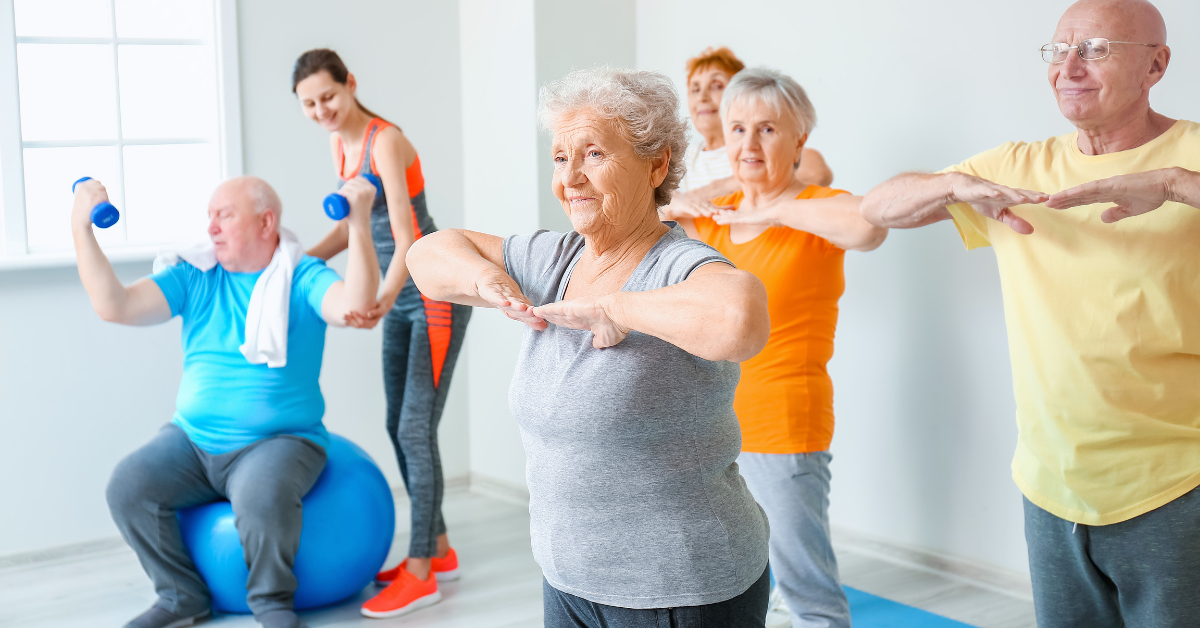
Most older adults prefer living out the rest of their lives in their familiar homes rather than moving to a senior living community for several reasons. Firstly, they do not want to lose their independence and the freedom allowing them to make daily choices. Secondly, they do not want to lose the routine and community they built over the years. This is precisely what the aging in place concept addresses.
Aging in place requires planning. Independence in everyday activities, such as grocery shopping, stepping over a doorstep, or getting up off the couch, requires strength, balance, and mobility.
Fortunately, senior fitness is simple. You do not need to have lengthy workouts. Making some simple habit changes can help modify these activities to help you be independent and age in place.
Start With Everyday Activities
A very easy way to begin your fitness journey is by incorporating movements that you do on a daily basis into your routine.
Think about getting up from a dining chair without using your hands. It’s a terrific approach to build up your hips and legs and improve the strength you need to get up.
Start your day off with some chair stands. Get up as gently as you can, but with control. Restart yourself in the chair, and repeat the process a few times. Ease yourself into this until you can do more.
Other movements to consider are:
- Walk around the house several times a day.
- Improve everyday mobility by reaching your arms overhead.
- Practice stepping onto and off of a low step, holding a solid support.
- Enhance your functional strength by carrying items throughout the house.
- Get up and down from the floor safely, if it fits into your daily routine.
Even though some of the movements may seem simple, it is the simplicity of movements that can contribute the most to successful aging in place.
Add Strength Training Days to Your Schedule
There is a decline in muscle strength (1) that is caused by the aging process and is exacerbated by a lack of activity. It is important for everyday activities and for our overall autonomy that we maintain our strength, particularly in our legs and hips.
It is not necessary to use heavy weights to strengthen your legs.
A simple routine could include a wall-supported push-up, chair stands, and heel and leg raises.
You can also incorporate standing and sitting heel raises while waiting for the kettle, or stand and sit on the chair rail during television breaks.
These small moments add up.
A target to do strength exercises twice a week should be to develop your personalized program based on what you are able to do.
Don’t Treat Balance as an Afterthought
Having good balance allows you to move around your home without worry, and is very important for decreasing the likelihood of falls.
Balance exercises can be as simple as standing close to a kitchen counter and shifting your weight slowly from one foot to the other. You can also do exercises with one foot slightly in front of the other, and stand with one hand close to a solid surface.
As you get comfortable, make these exercises more challenging by decreasing the pressure you place on the counter.
Difficult balance exercises should not be attempted if you are unsteady. A family member, caregiver, or trained professional should assist you in selecting the appropriate exercises and should always be present for your safety.
Keep Walking, but Add Variety
Walking is the easiest and best way to maintain fitness as you age. Walking helps maintain mobility and fitness, as well as maintain the daily movement you need to age in place.
Sadly, walking by itself does not help develop all the skills you may need as you age. It should be combined with strength and balance exercises. (2)
You could take a 15-minute walk in the morning, do a few chair stands throughout the day, and add evening balance exercises.
The routine doesn’t have to be difficult; consistency is key.
If a longer walk just seems like too much, you can still be active by taking multiple shorter walks, either around your house or your neighborhood.
Simple Flexibility Work Can Keep Your Mobility In Check
Stiff muscles or joints can lead to difficulty in performing everyday movements.
Lack of flexibility in the joints can cause difficulty in movements associated with reaching into the cupboard, while walking and turning your head, putting on your shoes, or getting dressed.
So, try simple shoulder rolls, ankle stretches, and even just a quick seated twist, plus a stretch, any time you have a chance.
It might even be easier to perform multiple stretches each day rather than just one, lengthy stretching session.
Your Home Is a Gym, Too
Your home can really strengthen your workouts.
So, you’re stuck in place. Find little ways to get up. While on the phone, move into another room. Don’t put away all the dishes at once; put them away a couple at a time. Fold laundry standing up. Make more trips to the fridge to store groceries.
Smaller decisions result in movement throughout the day instead of relying on long stretches of formal workouts.
It is especially realistic for older adults via the aging-in-place method.
Physical ability and confidence are strongly correlated.
It can become more and more difficult to move, which leads to a decrease in confidence, move less and less, and become increasingly weaker.
The opposite is true too; it can become easier to move, which leads to an increase in confidence, move more and more, and become increasingly stronger.
These practical changes can affect greater distance walked, increased ease in getting up, more ease in turning, and increased ease in bag carrying.
Although they seem small, they are significantly correlated with independence at home.
Final Thoughts
Increasing mobility that enables people to live independently begins with small, repeatable movements. Strength and balance exercises, in addition to walking regularly throughout the day, help improve mobility and increase independence.
Practice safe movements where you are, and build from there. Small habits today can save you from having to rely on others to carry out the activities of daily living in the future.
REFERENCE:
- https://pmc.ncbi.nlm.nih.gov/articles/PMC3940510/
- https://www.aarp.org/health/healthy-living/essential-exercises-older-adults/

